
What Whole-Woman Readiness Means Before IVF
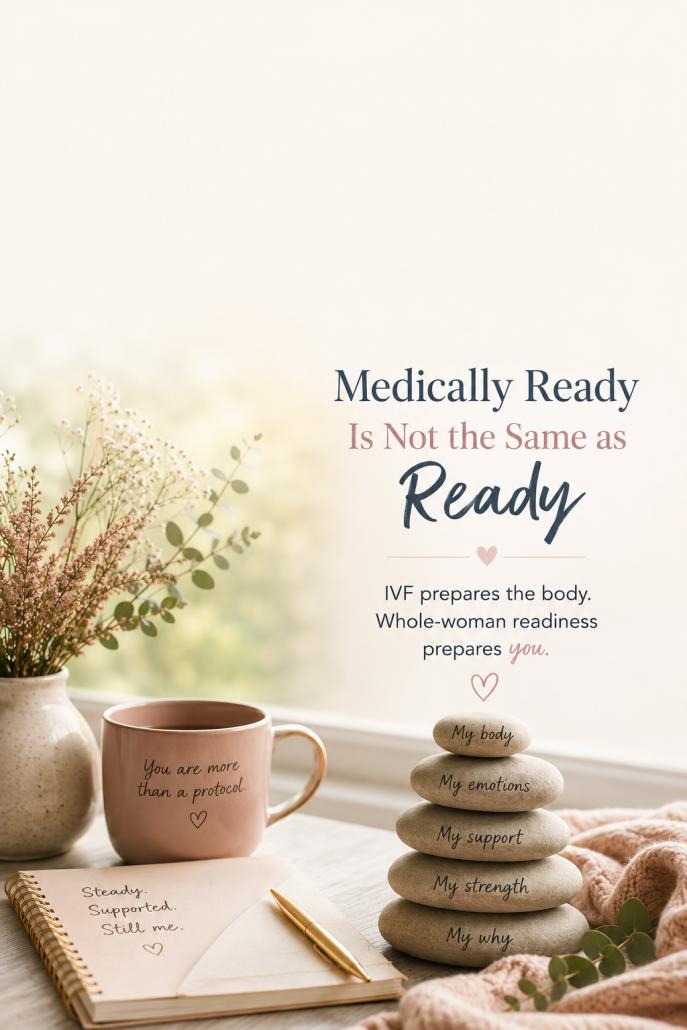
Medically Ready Is Not the Same as Ready
There is a particular kind of tired that can arrive when you are doing everything right for IVF and still do not feel ready.
You have read the protocol. The appointments are booked. The medications are lined up in the drawer. On paper, you are prepared.
And yet underneath, something has not caught up.
That gap can be hard to explain, especially when everyone around you sees how organised and committed you have been. But it is real. There is being medically ready for IVF, and there is being ready as a whole woman.
They are not the same thing.
And the difference can shape how the entire experience feels.
Two kinds of ready
Being medically ready usually means the treatment plan is in place.
You understand the medications, the monitoring, the timing, and the next steps. The clinic prepares this part carefully, and you have likely put a great deal into preparing for it as well.
Whole-woman readiness is something else.
It is quieter. More internal. Often harder to measure.
It can look like having a plan for the silence after transfer, not just the schedule before it. It can mean knowing what emotional weight you are carrying into this cycle and what you may need to put down. It can mean being able to make decisions under pressure without spiralling. It can mean feeling a little more connected to your body again after everything it has already been through.
One of these kinds of readiness is tracked closely.
The other is often left entirely to the woman herself.

Why this gap exists
IVF is designed to prepare the body for treatment. That is what medical care is there to do.
But it is not designed to prepare the woman as a whole.
That is not a criticism of clinics or specialists. It is simply the edge of what the medical model is built to hold. Protocols, timelines, blood tests, scans, and medications all matter. They attend to the patient.
But the woman inside the patient is often carrying something harder to see.
She may be holding hope and fear at the same time. She may be carrying grief she never had time to process. She may be exhausted from trying to stay functional, positive, and composed through months or years of uncertainty.
That part often sits outside the frame.
So many women arrive at IVF medically prepared and emotionally depleted. Not because they have done anything wrong, but because no one has really asked about the second half.
And that second half matters too.
What whole-woman readiness can involve
Whole-woman readiness is not a feeling that just appears on its own.
It is also not a wellness extra.
It is something that can be built, gently and deliberately, in the weeks before treatment begins.
For many women, it involves rebuilding some trust in a body that may feel confusing, disappointing, or distant. It may involve settling a nervous system that has been bracing for bad news for a long time. It can mean staying connected to who you are outside the cycle, so that being a patient does not quietly replace being a person.
It may also involve building the emotional capacity to face uncertainty without feeling consumed by it. Knowing who your real support is. Learning how to ask for what you need. Creating steadier ways to move through hard moments and difficult decisions.
This kind of preparation does not determine the medical outcome of a cycle.
But it can change how you live through it.
And that matters.
I did not learn about this gap from theory. I lived in it.
I know this difference because I spent a long time on the wrong side of it.
I followed every protocol. I took every medication. I kept every appointment. I stayed positive in front of everyone who asked. On paper, I was the model patient.
What no one had prepared me for was the moment afterwards. The moments that happen outside the clinic room. The car park after a transfer that did not work. The drive home when the grief had nowhere to go. The quiet unraveling that can happen when your body has been medically managed, but your emotional world has been left to hold itself.
It took me a long time, and eventually stepping away from treatment entirely, to understand that the medical preparation had only ever been half of it.
When I returned to IVF at 39, the difference was not a better protocol.
It was that I had finally done the other half of the work.
I walked in steadier. More supported. More prepared, rather than just bracing.
I conceived my son at 40.
I created The RISE Method™ because I lived in that gap. Not because I read about it. And the thing I most want women to know is that it does not have to be as lonely as it once was for me.
You do not have to reach the car park before someone helps you carry this.
A gentler way to prepare
If this feels familiar, there is nothing wrong with you.
You are not too sensitive. You are not overthinking it. It makes sense that you may feel tired, flat, fearful, or emotionally stretched, even if you are technically ready to begin.
You may be carrying the weight of years that no one has fully seen.
That is a lot.
And it is allowed to be a lot.
The good news is that emotional preparation can begin before treatment starts. Not in a dramatic way. Not by fixing everything. But by creating more steadiness, more support, and more room for you inside the process.
IVF prepares the body.
Whole-woman readiness prepares you.
If you would like a gentle place to begin, the 5-Minute IVF Steadiness Reset offers a simple practice to help your body remember it does not have to stay braced all the time. It is a small step, but for many women, small steps are where steadiness begins.
With gentle hope,
Margaret Cali








Leave a Reply
Want to join the discussion?Feel free to contribute!