
Margaret Cali
  • Home
  • The Rise Method™
  • Fertility Coaching
  • Workplace Support
  • Clinic Support
  • Free Resources
  • Blog
  • Scorecard
  • About Me
  • Contact
  • Click to open the search input field Click to open the search input field Search
  • Menu Menu

Tag Archive for: preparing for IVF

Your First IVF Appointment: How to Prepare Emotionally

09/11/2026/in Emotional Readiness Before IVF/by Margaret Cali

Booking your first IVF appointment can feel like a big step. For some women it brings relief. For others it brings fear, sadness or a feeling of “how did I get here?” Often it brings all of these at once.

Your clinic will tell you what paperwork to bring. Very few people talk about how to prepare yourself.

For years, I sat in clinic waiting rooms myself. I know how much you can carry into that room without anyone seeing it. This guide is about that side of your first IVF appointment: the emotional side.

Why your first IVF appointment can feel so big

On paper, a first appointment is a conversation. Your fertility specialist will usually go through your medical history, talk about any tests you have already had and suggest next steps.

Emotionally, it can feel much bigger than that.

It may be the first time you say out loud how long you have been trying. It may bring up past losses. It can feel like you are admitting something you hoped would never be needed.

If you feel nervous, teary or strangely flat before your appointment, nothing is wrong with you. You are about to talk about something that matters deeply to you, with someone you have only just met.

Questions to ask yourself before your first IVF appointment

Before you think about questions for the doctor, it can help to check in with yourself. You might like to write your answers down.

  1. What am I most worried about? Naming the fear often makes it a little smaller.

  2. What am I hoping to hear? It is natural to hope for good news. Knowing your hopes can help you notice if the conversation feels disappointing.

  3. What do I most need to understand by the end? Choose one or two things. You do not need to understand everything at the first visit.

  4. Who do I want with me? Your partner, a friend, your mum, or no one at all. Any of these is okay.

  5. What usually helps me when I feel overwhelmed? Fresh air, music, a walk, a quiet cup of tea? Plan one of these for after the appointment.

Many women I work with tell me they are coping well. Underneath, they are tired from holding everything together. If that sounds familiar, Am I Emotionally Ready for IVF? Six Situations to Consider may help you see where you are.

Support questions to ask your clinic

Most “questions to ask” lists focus on the medical side, such as tests, treatment options and costs. Those questions matter, and your clinic is the right place for them.

It is also worth asking about the support around your treatment. You could ask:

  • Do you have a fertility counsellor, and how do I book a session?

  • Who do I contact between appointments if I have a question or feel worried?

  • How will my results be shared with me? By phone, email or at an appointment?

  • Is it okay to bring someone with me to appointments?

  • Is there anything you can send me to read after today?

These questions are not a sign that you are not coping. They help you understand who is in your corner.

How to look after yourself on the day of your first IVF appointment

Small things can make a real difference on the day.

Give yourself time. Try not to squeeze your appointment between work meetings. Leave a little space before and after, so you are not rushing in or rushing out.

Bring your list. Write down your questions, including the support questions above. It is very common to forget everything the moment you sit down.

Take notes, or ask someone else to. A lot of information can come at you at once. Notes mean you can go back over it later, when you feel calmer.

It is okay to ask again. If something does not make sense, you can ask your doctor to explain it another way. You can also ask them to write things down.

You do not have to decide anything today. A first appointment is often about understanding where you are. Most decisions can wait until you have had time to think.

Plan something gentle for afterwards. A walk, a call with a friend, a favourite meal or a quiet evening at home. Whatever the appointment brings, you deserve some care afterwards.

After your first IVF appointment

Some women leave their first appointment feeling hopeful and clear. Others feel overwhelmed, or simply exhausted. Many feel something in between.

All of these responses are normal.

You may find that the feelings arrive later, once you are home. Give yourself a few days to take in what you heard before you make big plans.

If you have a partner, you may each react differently. One of you may want to talk it through straight away. The other may need time. Neither is wrong. It can help to agree on a time to talk, rather than trying to process it all in the car park.

And if you would like to read more about getting ready before treatment begins, How to Prepare Emotionally for IVF Before Treatment Begins is a good next step.

When to reach out for more support

Feeling nervous before your first IVF appointment is normal. But if worry is affecting your sleep, your work or your relationships, you do not need to wait until it gets worse.

Your clinic’s fertility counsellor is a good place to start. Your GP can also help.

If you are feeling persistently low, hopeless or unable to cope, please speak with your GP. If you are in crisis, call Lifeline on 13 11 14.

How an IVF coach can help you prepare

An IVF coach works alongside your clinic, not instead of it. Your clinic looks after the medical side. A coach helps with what you carry around it.

Before a first appointment, that might mean:

  • getting clear on what you want to ask and what matters most to you

  • naming the fears you are bringing into the room

  • planning how you will look after yourself on the day

  • making sense of how you feel afterwards

If you are new to coaching, What Is IVF Coaching? A Plain-English Guide explains the basics.

I am Margaret Cali, an IVF Readiness Integration Strategist and Certified Fertility Coach based in Sydney. I work online with women across Australia and internationally. My one-to-one program, The RISE Method™, helps women feel steadier and better prepared before and during IVF.

If you would like to talk about whether coaching could help you, you are welcome to get in touch. There is no pressure and no expectation.

With gentle hope,

Margaret Cali

About Margaret: Margaret Cali is an IVF Readiness Integration Strategist, Certified Fertility Coach and creator of The RISE Method™. Based in Sydney, she supports women preparing for and navigating IVF with practical emotional readiness support alongside their clinical care.

https://www.margaretcali.com.au/wp-content/uploads/2026/11/First-IVF-Appointment-Featured-Image-2.jpg 1034 1650 Margaret Cali https://www.margaretcali.com.au/wp-content/uploads/2026/07/Margaret-Cali-Logo-New.png Margaret Cali2026-11-09 19:18:532026-11-09 19:18:53Your First IVF Appointment: How to Prepare Emotionally

What Whole-Woman Readiness Means Before IVF

09/07/2026/in Emotional Readiness/by Margaret Cali

Medically Ready Is Not the Same as Ready

There is a particular kind of tired that can arrive when you are doing everything right for IVF and still do not feel ready.

You have read the protocol. The appointments are booked. The medications are lined up in the drawer. On paper, you are prepared.

And yet underneath, something has not caught up.

That gap can be hard to explain, especially when everyone around you sees how organised and committed you have been. But it is real. There is being medically ready for IVF, and there is being ready as a whole woman.

They are not the same thing.

And the difference can shape how the entire experience feels.

Two kinds of ready

Being medically ready usually means the treatment plan is in place.

You understand the medications, the monitoring, the timing, and the next steps. The clinic prepares this part carefully, and you have likely put a great deal into preparing for it as well.

Whole-woman readiness is something else.

It is quieter. More internal. Often harder to measure.

It can look like having a plan for the silence after transfer, not just the schedule before it. It can mean knowing what emotional weight you are carrying into this cycle and what you may need to put down. It can mean being able to make decisions under pressure without spiralling. It can mean feeling a little more connected to your body again after everything it has already been through.

One of these kinds of readiness is tracked closely.

The other is often left entirely to the woman herself.

Why this gap exists

IVF is designed to prepare the body for treatment. That is what medical care is there to do.

But it is not designed to prepare the woman as a whole.

That is not a criticism of clinics or specialists. It is simply the edge of what the medical model is built to hold. Protocols, timelines, blood tests, scans, and medications all matter. They attend to the patient.

But the woman inside the patient is often carrying something harder to see.

She may be holding hope and fear at the same time. She may be carrying grief she never had time to process. She may be exhausted from trying to stay functional, positive, and composed through months or years of uncertainty.

That part often sits outside the frame.

So many women arrive at IVF medically prepared and emotionally depleted. Not because they have done anything wrong, but because no one has really asked about the second half.

And that second half matters too.

What whole-woman readiness can involve

Whole-woman readiness is not a feeling that just appears on its own.

It is also not a wellness extra.

It is something that can be built, gently and deliberately, in the weeks before treatment begins.

For many women, it involves rebuilding some trust in a body that may feel confusing, disappointing, or distant. It may involve settling a nervous system that has been bracing for bad news for a long time. It can mean staying connected to who you are outside the cycle, so that being a patient does not quietly replace being a person.

It may also involve building the emotional capacity to face uncertainty without feeling consumed by it. Knowing who your real support is. Learning how to ask for what you need. Creating steadier ways to move through hard moments and difficult decisions.

This kind of preparation does not determine the medical outcome of a cycle.

But it can change how you live through it.

And that matters.

I did not learn about this gap from theory. I lived in it.

I know this difference because I spent a long time on the wrong side of it.

I followed every protocol. I took every medication. I kept every appointment. I stayed positive in front of everyone who asked. On paper, I was the model patient.

What no one had prepared me for was the moment afterwards. The moments that happen outside the clinic room. The car park after a transfer that did not work. The drive home when the grief had nowhere to go. The quiet unraveling that can happen when your body has been medically managed, but your emotional world has been left to hold itself.

It took me a long time, and eventually stepping away from treatment entirely, to understand that the medical preparation had only ever been half of it.

When I returned to IVF at 39, the difference was not a better protocol.

It was that I had finally done the other half of the work.

I walked in steadier. More supported. More prepared, rather than just bracing.

I conceived my son at 40.

I created The RISE Method™ because I lived in that gap. Not because I read about it. And the thing I most want women to know is that it does not have to be as lonely as it once was for me.

You do not have to reach the car park before someone helps you carry this.

A gentler way to prepare

If this feels familiar, there is nothing wrong with you.

You are not too sensitive. You are not overthinking it. It makes sense that you may feel tired, flat, fearful, or emotionally stretched, even if you are technically ready to begin.

You may be carrying the weight of years that no one has fully seen.

That is a lot.

And it is allowed to be a lot.

The good news is that emotional preparation can begin before treatment starts. Not in a dramatic way. Not by fixing everything. But by creating more steadiness, more support, and more room for you inside the process.

IVF prepares the body.

Whole-woman readiness prepares you.

If you would like a gentle place to begin, the 5-Minute IVF Steadiness Reset offers a simple practice to help your body remember it does not have to stay braced all the time. It is a small step, but for many women, small steps are where steadiness begins.

With gentle hope,
Margaret Cali

https://www.margaretcali.com.au/wp-content/uploads/2026/07/ChatGPT-Image-Jul-9-2026-10_03_18-PM.png 1536 1024 Margaret Cali https://www.margaretcali.com.au/wp-content/uploads/2026/07/Margaret-Cali-Logo-New.png Margaret Cali2026-07-09 22:07:262026-10-12 20:49:18What Whole-Woman Readiness Means Before IVF

Why Doing Everything Right Still Doesn’t Feel Like Enough

22/03/2026/in Emotional Readiness Before IVF/by Margaret Cali

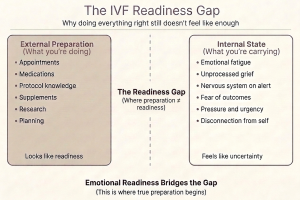
Many women preparing for IVF focus on the medical steps, but emotional readiness for IVF can still feel out of reach. You can be doing everything right before IVF and still not feel ready inside.

That is not a personal failure.
It is a preparation gap.
And it is one that is rarely named.

What “Prepared” Looks Like Before IVF

When a woman prepares for IVF, she is guided through a clear and structured process.

She learns about the protocol.
She understands the medications.
She attends appointments.
She asks questions.
She follows every step carefully.

From the outside, this looks like readiness.

She is informed, organised, and doing everything she has been told will support her chances.

And yet, for many women, there is a quiet feeling underneath all of this.

Something is not quite steady.

The Readiness Illusion

This is what I call the Readiness Illusion.

It is the experience of being fully prepared on paper, while internally feeling depleted, uncertain, or disconnected.

A woman can be highly capable and deeply committed, and still not feel resourced for what lies ahead.

Not because she has missed a step.
But because of what she has already been carrying.

What IVF Preparation Often Doesn’t Account For

By the time a woman reaches IVF, she has often already been through a long and demanding journey.

Months, sometimes years, of trying to conceive.
Cycles of hope followed by disappointment.
Decisions, appointments, waiting, and uncertainty.

Over time, the nervous system adapts.

It learns to stay alert.
It learns to brace.
It learns to keep moving forward, even when there has been little space to process what has happened.

From the outside, this can look like resilience.

But internally, something may have shifted.
Not broken.
But no longer fully resourced.

Research in chronic stress and allostatic load helps us understand this more clearly.

When a system has been under prolonged demand, it does not automatically return to a regulated state simply because circumstances change.
It often continues to operate in a more protective mode.

In the context of IVF, this means a woman may enter treatment with a well-prepared body, but a nervous system that is still quietly bracing for what comes next.

She is functioning.
She is continuing.
She is managing what needs to be managed.

But she may no longer be operating from a place of internal steadiness.

That distinction matters.

Why This Matters for IVF

IVF is not only a medical process.
It is an emotional one.

It asks a great deal of a woman, not only physically, but mentally and emotionally.

The decisions.
The waiting.
The uncertainty.
The outcomes.

If she enters this process already depleted, already carrying a significant emotional load, that state may quietly shape every stage of treatment.

Without emotional readiness for IVF, even the most well-planned cycle can feel heavier than it needs to be.

This is not about blame.
It is about recognising that preparation is incomplete if it only addresses the body.

Emotional Readiness: The Missing Piece

Emotional readiness is not about being calm or positive.
It is not about eliminating fear before your first injection.

It is about being resourced enough to stay present with yourself through a process that matters deeply to you.

I know what it looks like when that resource runs out, because I have been there.

By 35, after years of fertility challenges, I reached a point of complete depletion.
Physical exhaustion, emotional strain, and a sense that I could not continue in the way I had been.

I stepped away.

What followed was a period of rebuilding.
My health, my emotional capacity, and my relationship with my own body.

At the time, I did not realise that this work would become the foundation of everything I now teach.

When I entered IVF at 39, something had shifted.

I was no longer bracing in the same way.
I was not pushing through.
I felt more steady within myself.

And I have come to understand why that matters.

The body often responds differently when the nervous system is no longer in a sustained state of protection.

Emotional readiness for IVF is not separate from the physical process.
It sits alongside it.

A Different Way to Prepare

If you are preparing for IVF, this kind of preparation may begin with something quieter than another supplement or another appointment.

It begins with an honest check-in.

  • What is actually happening inside you, not just what you are doing
  • What your body has been holding across this journey
  • What still feels unresolved
  • Where you have support, and where you may need more
  • What “ready enough” looks like for you, not perfect readiness, but sufficient support

This is not about fixing yourself before you are allowed to proceed.

It is about understanding your starting point, so that treatment does not happen in spite of your emotional state, but alongside it.

IVF Prepares the Body. Emotional Readiness Prepares the Woman.

The medical side of IVF is essential.
But it is only one part of the preparation.

When emotional readiness for IVF is included alongside clinical care, something shifts.

A woman does not need to force herself into readiness.
She can be supported into it.

A Gentle Place to Begin

If something in this resonates, it may be helpful to gently understand where your system is currently sitting before your next step.

The IVF Emotional Readiness Scorecard is a simple, 7-minute check-in designed to help you see how steady, supported, and prepared you feel before entering treatment.

It is not a test.
It is a starting point.

With gentle hope,
Margaret Cali 💜
Fertility & Mindset Coach


https://www.margaretcali.com.au/wp-content/uploads/2026/03/Post-diagram-Why-Dong-Everything-Right-Still-Doesnt-Feel-like-Enough.jpg 675 1200 Margaret Cali https://www.margaretcali.com.au/wp-content/uploads/2026/07/Margaret-Cali-Logo-New.png Margaret Cali2026-03-22 20:47:372026-10-12 20:49:18Why Doing Everything Right Still Doesn’t Feel Like Enough

Margaret Cali

Recent Posts

  • Your First IVF Appointment: How to Prepare Emotionally
  • What Is IVF Coaching? A Plain-English Guide
  • What Do People Ask an IVF Coach? Common Fertility Coaching Questions Answered
  • Am I Emotionally Ready for IVF? Six Situations to Consider
  • The Two-Week Wait After IVF: How to Cope Without Living Tomorrow Today
  • What Whole-Woman Readiness Means Before IVF
  • How to Prepare Emotionally for IVF Before Treatment Begins
  • Feeling Overwhelmed Before IVF Begins: Why It Happens and What Helps
  • Why Doing Everything Right Still Doesn’t Feel Like Enough
  • Protection Mode vs Creation Mode: The Missing Conversation in IVF Preparation
  • Emotional Shutdown During Fertility: When “I’m Fine” Is a Survival Response
  • Why IVF Feels So Hard on Your Relationship And What It’s Really Trying to Show You
Search Search

Contact Margaret

T: 0409 304 003
E: mcalicoaching@gmail.com
A: Ashbury NSW 2193

Member, Fertility Society of Australia and New Zealand (FSANZ)

© 2026 Margaret Cali. All rights reserved.

Business Hours

Monday: 9am – 5pm
Tuesday: 9am – 5pm
Wednesday: 9am – 5pm
Thursday: 9am – 5pm
Friday: 9am – 5pm

Based in Australia, I also support clients internationally. Sessions are by appointment, with flexible times to suit busy schedules and different time zones.

Recent Posts

  • Your First IVF Appointment: How to Prepare Emotionally
  • What Is IVF Coaching? A Plain-English Guide
  • What Do People Ask an IVF Coach? Common Fertility Coaching Questions Answered
  • Am I Emotionally Ready for IVF? Six Situations to Consider
  • The Two-Week Wait After IVF: How to Cope Without Living Tomorrow Today
Scroll to top Scroll to top Scroll to top