Tag Archive for: nervous system regulation

Protection Mode vs Creation Mode: The Missing Conversation in IVF Preparation

For years, IVF preparation has been framed as a checklist.

The right supplements.
The optimal hormone levels.
The perfect protocol.

We prepare the body carefully.

But we rarely prepare the environment the body is operating in — the nervous system.

And that environment matters more than most women realise.

When we enter the IVF tunnel, many of us shift into what I call Protection Mode.

We become investigators of our own bodies.

Tracking.
Monitoring.
Scanning for signs.

It feels responsible.

But prolonged vigilance has a cost.

What Psychological Safety Actually Means

In fertility care, psychological safety is not about “staying positive.”

It is the felt sense that your body is not under threat.

It is the difference between your system feeling urgent and braced,
and feeling steady and regulated.

When your nervous system perceives safety, stress chemistry reduces and the body has greater capacity for repair and regulation.

Safety does not guarantee pregnancy.

But it changes the internal conditions in which conception is attempting to occur.

The Toll of Long-Haul IVF

Long-haul IVF often creates chronic vigilance.

You track LH peaks.
You analyse progesterone levels.
You read statistics late at night.

Over time, constant monitoring can keep the stress response activated.

When the brain repeatedly perceives threat or uncertainty, the HPA axis remains engaged. Elevated stress activation can influence sleep, digestion, immune signalling, and hormonal balance.

This is not about blame.

It is about biology.

Protection Mode is adaptive.

But it is not the same as Creation Mode.

From Collapse to Recovery

At 35, I was doing everything “right.”

Following protocols.
Researching obsessively.
Trying to control every variable.

From the outside, I looked capable.

Inside, I was depleted.

I realised that while I was managing the strategy, I had never addressed the state.

My recovery did not begin with a new supplement.

It began when I stopped supervising my body and started rebuilding trust with it.

Less data.
More steadiness.
Less urgency.
More safety.

By the time I entered IVF at 39, my internal environment had shifted.

Not from control.

From regulation.

Why Most Clinics Prepare the Body, Not the Environment

Fertility clinics are exceptional at medical preparation.

They optimise follicles.
Time medication precisely.
Track hormone levels with extraordinary skill.

But emotional readiness is rarely measured.

And yet chronic stress activation can influence reproductive hormones, immune function, and treatment engagement.

When patients do not feel psychologically safe:

They underreport distress.
They disengage quietly.
They withdraw when cycles fail.

Emotional readiness is not a “nice extra.”

It is infrastructure.

Moving From Protection to Creation

Emotional readiness is the shift from managing your body to partnering with it.

From vigilance to regulation.

From urgency to steadiness.

Creation Mode does not remove uncertainty.

It increases your capacity to hold it.

Before your next cycle, ask yourself:

Am I moving forward from pressure —
or from steadiness?

A Gentle Next Step

If you are preparing for IVF in the next few months and want clarity about where your emotional readiness stands, I created a 7-minute IVF Emotional Readiness Scorecard.

It measures ten domains of preparation and highlights whether your system is operating in Protection Mode or Creation Mode.

You do not need to be fearless.

You only need to feel safe enough to begin.

Take the Scorecard here:
👉 https://form.typeform.com/to/LMWq32X0

Emotional Shutdown During Fertility: When “I’m Fine” Is a Survival Response

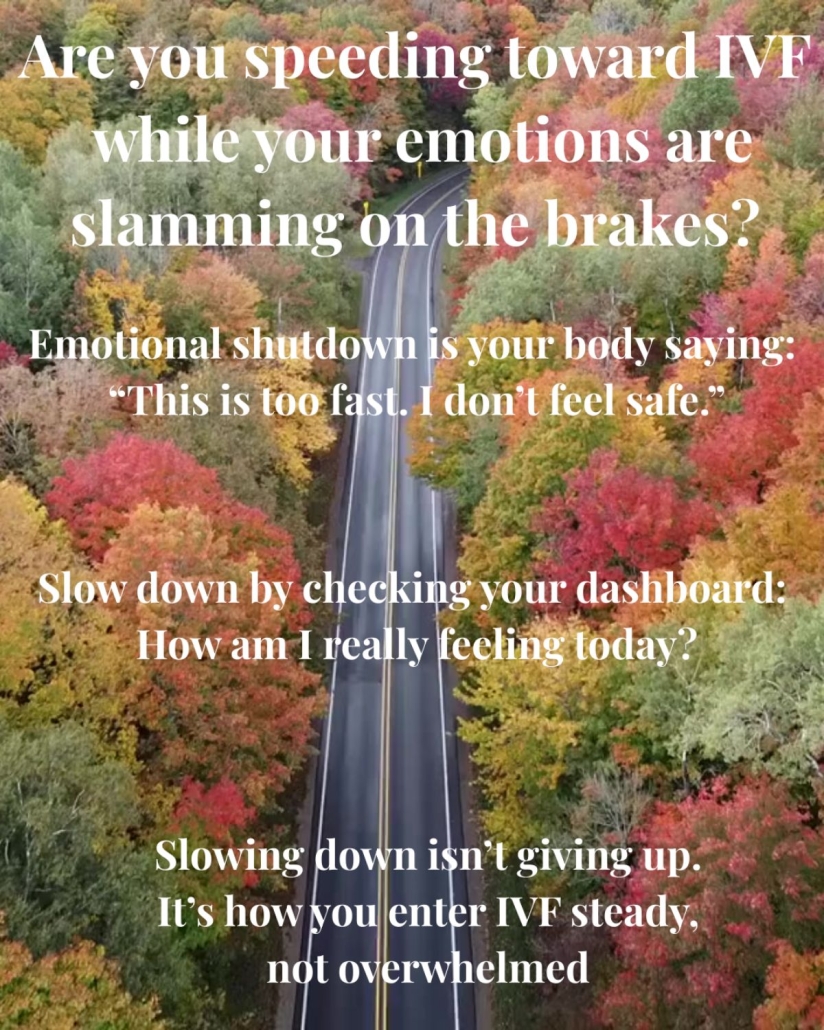
There is a particular phrase many women learn to say during fertility struggles:

“I’m fine.”

It’s offered in work meetings, in conversations with friends who don’t know what to ask, and sometimes even to partners or clinicians. On the surface, it sounds reassuring. But for many women navigating fertility challenges or IVF, this phrase isn’t reassurance at all.

It’s a survival response.

What Emotional Shutdown Really Looks Like

Emotional shutdown is rarely dramatic. It doesn’t always involve tears or visible distress. More often, it shows up quietly, in ways that are easy to miss.

It may look like:

  • staying busy or highly productive to avoid feeling

  • feeling flat or numb rather than actively sad

  • minimising your emotions to keep others comfortable

  • functioning well on the outside while feeling disconnected inside

Internally, something has gone quiet. Not because you’re weak or avoiding reality, but because your nervous system is protecting you from overload.

The Science of Protection: Hypo-arousal and Fertility Burnout

When fertility challenges are prolonged or medically complex, the repeated cycle of hope and disappointment keeps the stress response switched on. Over time, the body may move out of fight-or-flight and into hypo-arousal.

This is a state of emotional blunting or withdrawal. It’s the nervous system’s way of saying, “This is too much to feel all at once.”

In my work, this often appears alongside fertility burnout. Women are not just tired. They’re depleted after years of managing uncertainty, pressure, and private grief.

Shutdown can feel safer than:

  • answering questions you don’t have the energy for

  • risking hope again

  • fully feeling what has already been lost

This response is not a failure. It’s adaptive.

Fertility burnout isn’t a personal failure. Emotional readiness is a supported state.

When Shutdown Becomes a Self-Worth Crisis in Disguise

When emotional shutdown lasts too long, it can quietly erode self-worth.

Women often begin to:

  • measure their value by test results

  • equate outcomes with personal success or failure

  • disconnect from their identity outside fertility

  • feel invisible, even in supportive relationships

This is not because something is wrong with you. It’s what happens when emotional load goes unrecognised for too long.

Why Emotional Readiness Matters Before IVF

Many women enter IVF medically prepared but emotionally depleted. Years of fertility burnout mean emotional resources are already low before treatment begins.

When shutdown goes unrecognised, IVF can feel even more isolating. Decisions feel heavier. Communication with partners becomes strained. Women often describe going through the motions while quietly disappearing inside.

This is why emotional readiness matters before IVF begins.

Emotional readiness does not mean being calm or positive all the time. It means having enough internal safety to stay connected to yourself while navigating uncertainty.

Bridging Survival Mode Back to Clarity

In my work as a Fertility and Mindset Coach, the focus is never on forcing emotions open or “pushing through.” Instead, it’s about restoring safety first.

Through The RISE Method and my Holistic Fertility Foundations Framework (ALIGN), I support women to gently move out of survival mode and back into a state of clarity, steadiness, and self-trust. These frameworks are grounded in nervous system regulation, emotional integration, and body partnership, rather than pressure or performance.

I bring over 30 years of professional experience in leadership and education, blending evidence-informed approaches with compassionate coaching. I also know this road personally. My own journey through PCOS, pregnancy loss, and male factor infertility eventually led to IVF success at age 40.

That combination of lived experience and structured emotional frameworks allows women to reconnect with themselves without overwhelm, and to enter IVF feeling prepared rather than depleted.

Reconnecting Without Forcing Emotion

Reconnection doesn’t require you to feel everything at once. In fact, forcing emotion can deepen shutdown.

Gentle reconnection begins with:

  • Acknowledgement: recognising shutdown as protective, not pathological

  • Nervous system regulation: restoring internal safety before demands increase

  • Permission: meeting yourself where you are, without judgement

You are not broken.
You are not cold.
You are not failing at coping.

You are carrying a lot.

By Margaret Cali, Fertility & Mindset Coach

Fertility challenges do not happen in isolation.

They happen inside relationships.
Inside shared hopes.
Inside conversations that slowly become harder to have.

Many couples enter fertility treatment believing that love and commitment will be enough to carry them through.

Often, they are surprised by how much strain IVF places on even the strongest partnerships.

This does not mean the relationship is failing.
It means the pressure is real.

How Fertility Burnout Shows Up in Relationships

Fertility burnout does not only affect the individual going through treatment.

It seeps into:

  • Communication

  • Intimacy

  • Emotional availability

  • How partners interpret each other’s responses

Common experiences include:

  • Feeling alone even with a supportive partner

  • One partner wanting to talk, the other shutting down

  • Scheduled intimacy replacing connection

  • Avoiding difficult conversations to “keep the peace”

  • Carrying grief privately to protect the other

Many couples are still showing up.
They are still committed.
But something feels heavier than it used to.

Support Is Not the Same as Alignment

One of the most painful experiences women describe is this:

“My partner is supportive, but I still feel alone.”

Support often looks like:

  • Attending appointments

  • Saying the right things

  • Wanting to fix the problem

  • Staying optimistic

But alignment requires something different.

Alignment means:

  • Shared understanding of emotional load

  • Language for fear, grief, and uncertainty

  • Agreement on how to handle outcomes

  • Permission for both partners to struggle differently

Without this, couples can unintentionally drift apart while trying to protect each other.

The Invisible Load Many Women Carry

In fertility treatment, women often carry an invisible emotional and mental load.

This may include:

  • Tracking cycles and medications

  • Managing appointments and results

  • Absorbing family questions

  • Holding hope and disappointment simultaneously

  • Regulating everyone else’s emotions while suppressing their own

Partners carry weight too.
Often silently.

But when the load is uneven or unspoken, resentment and misunderstanding can grow.

Not because of a lack of love.
But because of a lack of shared language.

Why IVF Amplifies Relationship Patterns

IVF does not create relationship problems.

It amplifies what already exists.

Patterns around communication, conflict, avoidance, or emotional expression become more visible under pressure.

Couples may notice:

  • Old coping strategies no longer work

  • Small misunderstandings feel bigger

  • Emotional shutdown in one partner triggers fear in the other

  • Both partners feel misunderstood in different ways

This is not a sign to panic.
It is a sign to slow down.

What Helps Couples Stay Connected During Fertility Treatment

Connection during fertility challenges does not come from trying harder.

It comes from clarity.

Helpful shifts often include:

  • Naming what each partner is actually feeling

  • Asking for specific support rather than assuming

  • Agreeing on boundaries with family and friends

  • Remembering that you are on the same side

  • Making space for grief and hope to coexist

Sometimes, the most protective thing a couple can do is learn how to talk about the hard parts without trying to solve them immediately.

Preparing the Relationship, Not Just the Body

Most clinics prepare the body for IVF.

Very few prepare the relationship.

Emotional readiness before treatment includes:

  • Communication tools

  • Nervous system regulation

  • Shared expectations

  • Space to process fear together

  • Permission to not be “strong” all the time

When couples feel emotionally prepared, IVF still feels challenging — but less isolating.

You Are Not Doing This Wrong

If your relationship feels strained, distant, or fragile during fertility treatment, it does not mean you are failing.

It means you are navigating one of the most stressful experiences a couple can face.

With support, language, and intention, many couples find their way back to connection — sometimes with more depth and honesty than before.

Where to Go From Here

If this post resonated, you may also find these helpful:

Emotional Shutdown During Fertility: When “I’m Fine” Is a Survival Response

By Margaret Cali, Fertility & Mindset Coach

There is a particular phrase many women learn to say during fertility struggles.

“I’m fine.”

It is said at work meetings.
It is offered to friends who do not know what to ask.
It is used with partners, family members, and clinicians.

And often, it is not true.

For many women navigating fertility challenges or IVF, “I’m fine” is not reassurance.
It is a survival response.

What Emotional Shutdown Really Looks Like

Emotional shutdown does not always look dramatic.

It rarely involves tears in public or visible distress.
More often, it looks like:

  • Staying busy and productive

  • Minimising your own feelings

  • Feeling flat rather than sad

  • Avoiding conversations you do not have the energy to manage

  • Functioning well on the outside while feeling disconnected inside

You may still be doing everything you are supposed to do.
Showing up.
Following protocols.
Holding it together.

But internally, something has gone quiet.

This is not weakness.
It is the nervous system protecting you from overload.

The Nervous System and Fertility Stress

When fertility becomes prolonged, uncertain, or medically complex, the nervous system can remain in a heightened state of alert.

Repeated disappointment, waiting, loss, and decision pressure activate the body’s stress response.
Over time, this can lead to one of two common patterns:

  • Hyper-arousal: anxiety, racing thoughts, vigilance

  • Hypo-arousal: numbness, withdrawal, emotional blunting

Emotional shutdown often belongs to the second category.

It is the body saying, this is too much to feel all at once.

In fertility contexts, this response is common.
And it is often misunderstood.

Why Women Shut Down Emotionally During Fertility

Emotional shutdown is rarely conscious.

It develops because:

  • There have been too many disappointments to process safely

  • Hope feels risky

  • There is pressure to stay positive

  • You are expected to keep functioning while grieving privately

  • You do not feel you have permission to fall apart

For many women, shutting down becomes the only way to continue.

Especially when IVF enters the picture.

“I’m Fine” as a Coping Strategy

Saying “I’m fine” can feel easier than explaining what you do not yet have words for.

It can feel safer than inviting questions you do not have the capacity to answer.
It can feel protective when your body already feels exposed.

But over time, this coping strategy can come at a cost.

Emotional shutdown may create distance from:

  • Your own internal signals

  • Your partner

  • Decision clarity

  • Your sense of identity beyond fertility

Not because you are doing anything wrong.
But because you are surviving.

Why Emotional Shutdown Matters Before IVF

Many women enter IVF medically prepared but emotionally depleted.

They have already spent years managing stress, disappointment, and uncertainty.
By the time IVF becomes an option, emotional resources are often low.

If emotional shutdown is not recognised, IVF can feel even more isolating.

Decisions become harder.
Communication can feel strained.
Fear becomes quieter but heavier.

This is why emotional readiness matters.

Not to force positivity.
Not to eliminate fear.
But to gently reconnect with yourself before the demands increase.

Reconnecting Without Forcing Emotion

Reconnection does not mean pushing yourself to feel everything at once.

It begins with safety.

With noticing.
With permission.
With understanding that shutdown was adaptive.

Supportive emotional work before IVF focuses on:

  • Regulating the nervous system

  • Restoring a sense of internal safety

  • Creating space to feel without becoming overwhelmed

  • Rebuilding trust with your body

This is not about “opening up” on demand.
It is about meeting yourself where you are.

You Are Not Broken

If you recognise yourself here, know this:

You are not cold.
You are not detached.
You are not failing at coping.

Your system has been carrying a lot.

Emotional shutdown is not the absence of feeling.
It is the presence of protection.

And with the right support, it can soften.

Where to Go From Here

If this article resonated, you may find these supportive:

How the RISE Method Supports Fertility Burnout Before IVF

By Margaret Cali, Fertility & Mindset Coach

Most women don’t enter IVF feeling calm or resourced.
They arrive already carrying years of pressure, loss, decision fatigue, and silent fear.

By the time IVF becomes an option, fertility burnout is often already present.

Not because they’ve done anything wrong.
But because prolonged uncertainty, repeated disappointment, and sustained emotional load take a toll on the nervous system, identity, and sense of self.

This is where emotional readiness matters.

Fertility Burnout Doesn’t Disappear When IVF Begins

Many women assume IVF will bring relief.
A plan. A timeline. A sense of control.

Many women enter IVF medically prepared but emotionally depleted, as fertility treatment often focuses on protocols rather than emotional readiness, even within leading providers such as IVF Australia.

But for women already in fertility burnout, IVF can amplify what is already strained:

• A nervous system stuck in fight-or-flight
• A body that feels unsafe or untrustworthy
• A mind constantly scanning for threat or failure
• A deep fear of “I can’t go through this again”

Without emotional preparation, IVF often becomes something women endure rather than experience with steadiness and agency.

Why Emotional Support Needs Structure

Support alone is not enough.

Many women have supportive partners, kind doctors, and well-meaning friends — yet still feel alone.

What’s missing is structure.

Structure helps the nervous system settle.
Structure reduces decision fatigue.
Structure creates emotional containment when uncertainty is unavoidable.

This is the gap the RISE Method was created to fill.

What the RISE Method Addresses

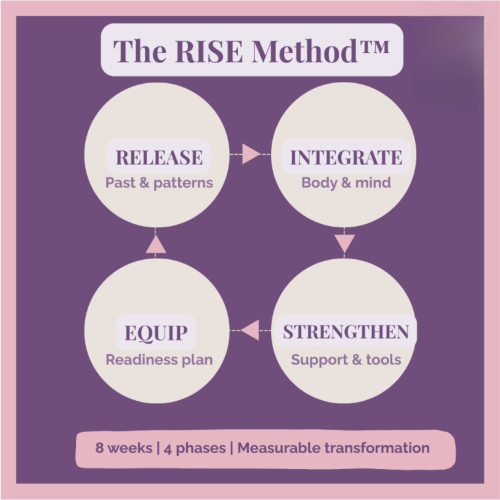
The RISE Method is an emotional preparation framework designed to support women before IVF begins — when burnout is present, but often unspoken.

It focuses on four core phases:

Release

Letting go of accumulated pressure, self-blame, and emotional suppression.
This phase supports nervous system regulation and reduces survival-mode functioning.

Integrate

Processing grief, fear, and hope together — rather than oscillating between numbness and overwhelm.
This phase restores emotional coherence and internal steadiness.

Strengthen

Rebuilding self-trust, body partnership, and emotional resilience.
This phase helps women feel more capable of meeting what IVF asks of them.

Equip

Developing practical emotional tools for decision-making, boundaries, communication, and both-outcomes preparation.
This phase supports women to enter IVF feeling prepared, not desperate.

What Changes When Burnout Is Addressed Before IVF

When fertility burnout is supported emotionally before treatment begins, women often report:

• Clearer thinking and decision-making
• Reduced anxiety and emotional reactivity
• A calmer relationship with their body
• Greater emotional steadiness during appointments and waiting periods
• Stronger communication with partners and support systems

This does not promise outcomes.
It protects wellbeing, identity, and emotional integrity — regardless of outcome.

Emotional Readiness Is Not a Luxury

IVF places real demands on the nervous system, relationships, and sense of self.

Preparing emotionally is not about “positive thinking” or trying harder.
It is about entering treatment resourced rather than depleted.

Just as clinics prepare the body medically, emotional readiness prepares the woman.

Where This Fits in the Bigger Picture

If you’re recognising signs of fertility burnout in yourself, you may wish to start with understanding the burnout cycle itself.

You may also find it helpful to explore how fertility burnout leads to emotional shutdown, or how it impacts relationships over time.

Emotional support is not an optional extra in fertility care.
It is part of doing this well.

With gentle support,
Margaret Cali
Fertility & Mindset Coach

The Truth About Fertility Burnout — And Why Emotional Readiness Matters More Than You Think

The Truth About Fertility Burnout — And Why Emotional Readiness Matters More Than You Think

By Margaret Cali, Fertility & Mindset Coach

At 35, I couldn’t get out of bed on Mondays.
At 40, I held my miracle son.

What changed wasn’t a new protocol.
It was my emotional readiness.

I began my fertility journey at 25. By 35, I was completely burnt out.

Not tired.
Not “just stressed.”
Burnt out in the way that quietly dismantles your sense of self.

I was consumed by late-night Googling, obsessing over symptoms, blaming my body, and living in a constant state of fight-or-flight. I felt like I was failing at the one thing that was meant to come naturally.

The burnout became so deep that I took time off teaching because I could no longer function. I withdrew from people. I cried alone in the dark. I remember watching the scene in Titanic where Rose wants to jump and realising, with startling clarity, that I understood her. I had tied my entire worth to my ability to conceive.

What I didn’t know then was this:

What I was experiencing wasn’t weakness.
It was fertility burnout, a self-worth crisis in disguise.

And I was far from alone.

What Fertility Burnout Actually Looks Like

Fertility burnout is rarely named, yet deeply familiar to women navigating infertility or IVF.

It often looks like this:

  • Losing your identity beyond trying to conceive

  • Ignoring physical symptoms such as headaches, gut issues, tension, and sleep disruption

  • Swinging between emotional numbness and emotional overwhelm

  • Feeling paralysed by decisions, terrified of choosing wrong

  • Withdrawing from friends, especially those with children

  • Measuring your worth by test results and outcomes

This is not being dramatic.
This is not a lack of resilience.

This is burnout.

The Fertility Burnout Cycle

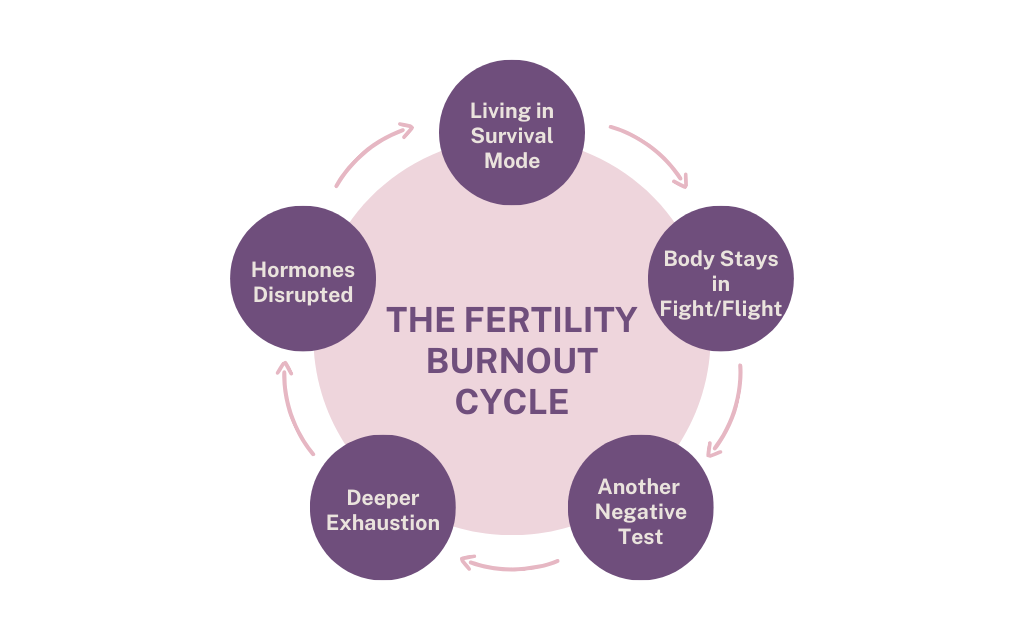
Many women find themselves trapped in a repeating loop:

A negative test → nervous system activation → hormonal disruption → deeper exhaustion → repeat

Over time, your body remains in survival mode. Decision-making becomes harder. Hope feels heavier. Joy narrows.

You are not “trying too hard.”
You are depleted.

What the Research Shows

Recent research validates what so many women experience quietly:

  • Psychology Today (2025) describes fertility burnout as “when hope becomes exhaustion.”

  • Psychiatric Times (2025) highlights how chronic fertility stress activates the HPA axis, disrupting reproductive hormones and emotional regulation.

  • Human Reproduction (2022) reports that women undergoing fertility treatment while working experience significant overwhelm, anxiety, and identity fragmentation.

Over half report decreased job satisfaction during fertility treatment, and one in three consider leaving their job due to the emotional load.

These are not personal flaws.
They are predictable nervous system responses to prolonged stress.

Why Emotional Readiness Matters Before IVF

Most women enter IVF medically prepared but emotionally depleted.

Research into emotional preparation shows that when women first consider IVF, emotional readiness often sits around 30 percent. After structured emotional support, that readiness can rise to nearly 80 percent.

This does not guarantee pregnancy.
But it profoundly changes how treatment is experienced.

Think of it this way:

You wouldn’t plant seeds in depleted soil.
So why begin IVF emotionally depleted?

Clinics prepare your body.
But who prepares your nervous system?
Your identity?
Your capacity to cope with uncertainty?

This gap is where burnout deepens.

Why Emotional Readiness Matters Before IVF

Most women enter IVF medically prepared but emotionally depleted.

Research into emotional preparation shows that when women first consider IVF, emotional readiness often sits around 30 percent. After structured emotional support, that readiness can rise to nearly 80 percent.

This does not guarantee pregnancy.
But it profoundly changes how treatment is experienced.

Think of it this way:

You wouldn’t plant seeds in depleted soil.
So why begin IVF emotionally depleted?

Clinics prepare your body.
But who prepares your nervous system?
Your identity?
Your capacity to cope with uncertainty?

This gap is where burnout deepens.

If You’re in Fertility Burnout Right Now

Here are five gentle ways to begin lightening the load:

  1. Create a boundary around late-night Googling
    Set a firm cut-off time. Searching for certainty often fuels anxiety rather than reassurance.

  2. Tell one person the truth
    Not “I’m fine,” but “This is really hard.” Naming the truth reduces emotional strain.

  3. Say no to one thing this week
    Protect your capacity. Rest is not failure.

  4. Shift from fighting your body to partnering with it
    Your body is not the enemy. The pressure is.

  5. Seek support that understands fertility burnout
    You do not have to carry this alone.

Where to Go From Here

If this article resonated, you may find these supportive:

  • How the RISE Method Supports Fertility Burnout Before IVF
    A deeper look at emotional readiness and how structured support helps women move out of survival mode before treatment begins.

  • Emotional Shutdown During Fertility: When “I’m Fine” Is a Survival Response
    An exploration of why numbness and emotional withdrawal are common responses to prolonged fertility stress.

  • Fertility Burnout and Relationships: Why IVF Tests Even the Strongest Partnerships
    How fertility burnout impacts communication, intimacy, and emotional connection within relationships.

If you’re wondering where you stand emotionally, you may also find clarity through the IVF Readiness Scorecard, a short assessment designed to highlight emotional strengths and gaps before treatment.

With gentle hope,
Margaret Cali
Fertility & Mindset Coach
Founder of the RISE Method™