
Margaret Cali
  • Home
  • The Rise Method™
  • Fertility Coaching
  • Workplace Support
  • Clinic Support
  • Free Resources
  • Blog
  • Scorecard
  • About Me
  • Contact
  • Click to open the search input field Click to open the search input field Search
  • Menu Menu

Tag Archive for: IVF anxiety

Am I Emotionally Ready for IVF? Six Situations to Consider

18/10/2026/in Emotional Readiness Before IVF/by Margaret Cali

You may know your IVF protocol.

You may have your appointments organised, understand your medication and know what happens next.

But emotionally, you may still be asking:

How am I going to do this?

Or perhaps:

How am I going to do this again?

Emotional readiness for IVF is not something you either have or do not have.

Sometimes the more useful question is:

What am I carrying into IVF, and where might I want more support?

The following situations are not measures of whether you are ready. They are starting points for noticing what support might help.

1. You are organised, but something still does not feel settled

On paper, everything may be ready.

You have completed the tests. The medication is organised. You have rearranged work and checked the calendar more times than you can remember.

Yet underneath all that preparation, you may still feel uneasy.

Medical preparation can tell you what is going to happen.

It cannot always prepare you for how you might experience it.

Feeling unsettled may simply mean there is another part of preparation that deserves some attention.

If this feels familiar, Why Doing Everything Right Still Doesn’t Feel Like Enough explores it further.

2. You keep researching because you want to feel certain

Research can be helpful.

Understanding your treatment can give you questions to ask your medical team and help you feel more informed about decisions.

But sometimes researching shifts.

One article becomes ten. One question leads to another.

You find yourself searching late at night, comparing experiences or trying to work out what a symptom or result might mean before you have all the information.

At that point, you may no longer be searching only for information.

You may also be searching for certainty.

And IVF does not always give us that.

Emotional readiness can include recognising when information is supporting you and when the search for certainty is adding to what you are already carrying.

3. You say “I’m fine”, but there is more underneath

Sometimes “I’m fine” really does mean you are fine.

And sometimes it is simply the easiest answer.

Explaining fertility treatment can be exhausting. You may not want advice. You may not want another person asking whether you have “tried” something.

You may not even have the words to explain how you feel.

So you keep going.

Having somewhere you can be honest when you are not fine can matter, whether that is with your partner, someone you trust, your clinical team, your clinic’s counsellor or another appropriate source of support.

If “I’m fine” has become your automatic answer, Emotional Shutdown During Fertility may resonate.

4. You are already living through things that have not happened

What if the cycle is cancelled?

What if there are fewer eggs than expected?

What if the embryo does not develop?

What if the pregnancy test is negative?

Thinking ahead can feel like preparation.

And sometimes it is.

There is value in considering what you might need through different outcomes and putting support around yourself in advance.

But there is a difference between having a plan for what may happen and emotionally living through every possibility before it happens.

You can prepare for tomorrow without having to live tomorrow today.

This kind of thinking often becomes strongest after embryo transfer. The Two-Week Wait After IVF offers gentle ways through that stage.

5. What happened before is still coming with you

Starting another IVF cycle does not necessarily feel like a fresh start.

Your body and mind may remember the previous scan, the phone call, the pregnancy loss, the unsuccessful transfer or the cycle that did not go as expected.

You may know logically that this cycle is different and still notice fear appearing.

That does not necessarily mean you are stuck in the past.

It may mean something from the previous experience needs acknowledgement, support or space.

If you are carrying a pregnancy loss into treatment, Your Loss Still Matters was written with you in mind.

6. You are not sure what support you actually need

People may tell you:

“Let me know if you need anything.”

But what do you ask for?

Do you want your partner to listen rather than problem-solve?

Do you need fewer questions from family?

Would it help to speak with your clinic’s counsellor?

Do you need someone else to handle certain practical responsibilities during treatment?

Would you benefit from having strategies available for waiting periods such as the two-week wait?

Emotional support becomes more useful when it becomes specific.

Part of emotional readiness can be identifying what support looks like for you, rather than simply knowing that support exists.

If you are wondering whether a coach could be part of that support, What Do People Ask an IVF Coach? answers some of the most common questions.

This is not a test of whether you are ready enough

None of these experiences, on its own, tells you whether you are ready for IVF.

They may instead help you recognise The Readiness Gap™.

The Readiness Gap™ is the space between what IVF is asking of you emotionally and the support and resources you currently have available to meet those demands.

It is not a shortfall in you.

It is information about where support may help.

Five questions to ask yourself

Take a few quiet minutes and consider:

  1. What am I carrying right now?

  2. What am I trying to prepare myself for?

  3. What feels hardest at the moment?

  4. What is within my control today?

  5. What support would make this feel a little more manageable?

You may discover that you already have more resources around you than you realised.

Or you may recognise somewhere you would like additional support.

Either can help you understand what you need.

Emotional readiness is not about arriving at IVF without fear.

It is about understanding what you are carrying and strengthening the support around you as treatment unfolds.

IVF may be happening to your body. But it is the woman as a whole who is going through it.

A simple place to begin

If IVF feels like a lot right now, the 5-Minute IVF Steadiness Reset offers a short, practical way to pause and come back to what needs your attention today.

You can also explore The RISE Method™ if you would like to understand my structured approach to emotional readiness.

With gentle hope,

Margaret Cali

About Margaret: Margaret Cali is an IVF Readiness Integration Strategist, Fertility and Mindset Coach, and creator of The RISE Method™. She supports women preparing for and navigating IVF with practical emotional readiness support alongside their clinical care.
https://www.margaretcali.com.au/wp-content/uploads/2026/10/Emotionally-Ready-Featured-Image.jpg 1034 1650 Margaret Cali https://www.margaretcali.com.au/wp-content/uploads/2026/07/Margaret-Cali-Logo-New.png Margaret Cali2026-10-18 19:16:332026-10-24 16:33:41Am I Emotionally Ready for IVF? Six Situations to Consider

The Two-Week Wait After IVF: How to Cope Without Living Tomorrow Today

12/10/2026/in Emotional Readiness Before IVF/by Margaret Cali

The embryo transfer is done. The appointments have stopped. And suddenly, there is nothing left to do but wait.

For many women, the two-week wait after IVF is the hardest part of treatment.

Not because anything is happening that you can see. But because so much is happening inside you.

You may find yourself checking for symptoms, counting the days to your blood test, replaying the transfer and imagining every possible outcome, often all before lunchtime.

If that sounds familiar, there is nothing wrong with you. The two-week wait asks a great deal of a woman, and it often asks it quietly.

What is the two-week wait?

The two-week wait is the time between your embryo transfer and your pregnancy blood test. Your clinic will give you the exact date, and it is not always a full fourteen days.

On paper, it is a waiting period.

In real life, it can feel like holding your breath for days at a time.

During treatment, there is usually something to focus on. Medication. Scans. Egg collection. Phone calls from the clinic. Then the transfer happens and that structure falls away, leaving a lot of space for thoughts to fill.

Why the two-week wait can feel so hard

For many women, this wait does not stand on its own.

It may carry months or years of trying to conceive. It may carry an earlier transfer that did not work, or a pregnancy loss. It may carry the money, the time off work and the hope that has gone into getting to this point.

I call this The Quiet Load™ of IVF. It is the emotional weight a woman carries into and through treatment, much of which the people around her never see.

During the two-week wait, that load can feel heavier, because there is so little to do with it.

You may also notice:

  • Searching every twinge, cramp or lack of symptoms online
  • Feeling tempted to test early, then worrying about what you might see
  • Swinging between hope and preparing yourself for bad news
  • Finding it hard to concentrate at work
  • Feeling distant from your partner, or snapping at each other more than usual
  • Saying “I’m fine” because explaining it all feels exhausting

These are common responses to a very uncertain time. They are not signs that you are doing the wait wrong.

Living through outcomes that have not happened yet

One of the hardest parts of the two-week wait is how easily the mind moves ahead.

What if it is negative? What if it is positive and something goes wrong? What if I have to tell people again?

Thinking ahead can feel like protection. Part of you may hope that if you rehearse the disappointment now, it will hurt less later.

But living through every possible outcome in advance often means feeling it many times over, before you even know what is true.

There is a difference between gently considering what support you might need and living tomorrow today.

You can prepare for your results day without having to live it every day until it arrives.

If you are still preparing for treatment and wondering how you will cope, Am I Emotionally Ready for IVF? explores six situations worth considering.

Symptom spotting and testing early

Searching for symptoms is one of the most common experiences of the two-week wait.

It usually comes from a very understandable place. You want information. You want some sign of what is happening.

The difficulty is that the two-week wait rarely gives clear signs. Many clinics advise against testing early with a home pregnancy test, because the result may not be reliable before your scheduled blood test. If you have questions about symptoms or medication, your clinic is the right place to take them.

It can help to notice what happens in you when you search or think about testing early. Does it bring relief? Or does it leave you more unsettled than before?

That awareness is not about stopping yourself. It is about choosing what actually supports you.

Does stress during the two-week wait affect IVF?

This is a question many women carry, often silently.

You may worry that feeling anxious could somehow harm your chances. Then you feel anxious about being anxious.

The Society for Assisted Reproductive Technology’s patient guide explains that research shows stress does not make it less likely that IVF will work.

So if you are finding the wait hard, please hear this: your worry is not working against you. You do not need to force yourself to feel calm or positive for the sake of the outcome.

You deserve support during the two-week wait because it is hard, not because you need to manage your emotions perfectly.

Gentle ways to cope with the two-week wait

There is no single right way to get through the two-week wait. These are starting points, not rules.

Decide in advance how you want to handle results day

Think about where you want to be when the clinic calls, who you want with you and whether you would like to take the day off work. Having a plan can take some pressure off the days before.

Choose who you will tell, and when

Some women find comfort in having one or two people who know. Others prefer to keep the wait private. You are allowed to protect your privacy, and you can tell people you will share news when you are ready.

Tell your partner what helps

You and your partner may cope with the wait in very different ways. One of you may want to talk about it. The other may need distraction. Neither is wrong. Saying “I don’t need you to fix this, I just need you to listen” can make a real difference. If you are noticing more tension than usual, Why IVF Feels So Hard on Your Relationship explores this further.

Keep some structure in your days

Small, ordinary routines can help when everything else feels uncertain. A short walk, a regular call with a friend or a show you look forward to each evening can give your days some shape.

Give your worry a place to go

Some women find it helps to set aside a short time each day for worries, rather than holding them all day. Write them down, then gently close the notebook.

Have one practical tool ready

When the thoughts start racing, it helps to have something simple you can come back to. The 5-Minute IVF Steadiness Reset was created for exactly those moments.

Know where you can be honest

You do not have to hold this alone. Your clinic’s fertility counsellor, a trusted friend, your partner or someone who understands IVF can all be places where you do not need to say “I’m fine.” If “I’m fine” has become your automatic answer, Emotional Shutdown During Fertility may resonate.

When the two-week wait feels like too much

The two-week wait is often hard. But if you are finding it difficult to sleep, eat, work or get through the day, or if your distress feels overwhelming, please reach out to your clinic or your GP.

If you are in Australia and need support right now, you can contact Lifeline on 13 11 14 at any time.

You do not need to wait until things feel unbearable to ask for support.

You do not have to do the wait perfectly

There is no perfect way to get through the two-week wait.

Some days you may feel hopeful. Some days you may feel frightened. Some days you may feel both at once.

What matters is not whether you stay calm. It is whether you have support around you while you wait.

IVF may be happening to your body. But it is the woman as a whole who is going through it.

A simple place to begin

If the two-week wait feels like a lot right now, the 5-Minute IVF Steadiness Reset offers a short, practical way to pause and come back to today.

If you would like structured support through IVF, you can learn more about The RISE Method™.

With gentle hope,

Margaret Cali

About Margaret: Margaret Cali is an IVF Readiness Integration Strategist, Fertility and Mindset Coach, and creator of The RISE Method™. She supports women preparing for and navigating IVF with practical emotional readiness support alongside their clinical care.

https://www.margaretcali.com.au/wp-content/uploads/2026/10/Two-Week-Wait-Featured-Image.jpg 820 1650 Margaret Cali https://www.margaretcali.com.au/wp-content/uploads/2026/07/Margaret-Cali-Logo-New.png Margaret Cali2026-10-12 21:28:502026-10-18 19:54:44The Two-Week Wait After IVF: How to Cope Without Living Tomorrow Today

Feeling Overwhelmed Before IVF Begins: Why It Happens and What Helps

20/04/2026/in Emotional Readiness Before IVF/by Margaret Cali

Before IVF even begins, many women feel overwhelmed.

Not just nervous. Not just uncertain. But emotionally stretched in a way that can be hard to explain.

You may still be functioning. Going to work. Replying to messages. Turning up to appointments. Keeping life moving.

But underneath, something feels heavy.

And that can be confusing, because treatment has not even started yet.

Many women quietly wonder why they feel so much before the first injection, the first scan, or the first cycle begins. They may tell themselves they should be coping better. That they should feel more grateful to have a plan. That they need to stay strong and focus on what is next.

But feeling overwhelmed before IVF is more common than many women realise. And it often makes sense once you understand what your system may already be carrying.

Why IVF can feel overwhelming before it begins

IVF is often spoken about as something that starts with medication, appointments, and treatment dates.

But emotionally, it often begins much earlier.

By the time IVF becomes the next step, there has often already been a long lead-up. That may include months or years of trying, disappointment, loss, medical testing, waiting, hard conversations, financial stress, and the growing awareness of time.

None of that disappears just because there is now a treatment plan.

You do not begin IVF from a neutral place. You begin from everything you have already lived through on the way there.

That is part of why the lead-up can feel so intense. It is not just about what is coming. It is also about what has already been carried.

The emotional load that builds quietly

One of the reasons this stage can feel so heavy is because the emotional load often builds gradually.

It is not always one dramatic moment. More often, it is the steady accumulation of many things at once.

Holding hope and fear together. Trying to stay practical while emotionally tired. Making decisions while part of you still feels uncertain. Continuing daily life while something deeply important feels unresolved.

Many women become very good at coping during this time. They research. They organise. They keep going. They stay outwardly capable.

For some women, this can also be connected to slipping into a protective state, which I explore more in this article on protection mode in IVF preparation.

And often, other people see that and assume they are managing well.

But coping is not the same as feeling supported.

You can look organised and still feel emotionally stretched. You can be functioning and still feel close to your limit. You can be doing everything that needs to be done and still feel far from steady.

That difference matters.

IVF anxiety before starting: what it may be telling you

This is one of the questions many women carry quietly:

Why do I feel so overwhelmed when IVF has not even started yet?

There can be a temptation to judge yourself at this point. To assume you should be calmer, stronger, or more prepared.

But feeling anxious or overwhelmed before IVF often does not mean you are doing anything wrong.

It may mean your nervous system has been under pressure for longer than you realised.

It may mean you have been carrying more emotional weight than you have had space to process.

It may mean your body is responding to uncertainty, pressure, and cumulative stress in a very human way.

And it may mean that this next stage is asking more of you than simply getting organised.

In that context, overwhelm is not failure.

It is information.

It can be a signal that something in you needs care, support, and space before you move into treatment.

The pressure to hold it together

For many women, there is also a quiet pressure to keep going no matter how they feel.

You may feel like you need to stay strong. You may not want to worry other people. You may feel guilty for struggling when you are finally moving forward. You may tell yourself that because you are still functioning, it cannot be that bad.

So you continue.

You attend the appointments. You respond to the emails. You make the decisions. You keep life moving around the edges of something that feels emotionally significant.

From the outside, it may look like you are handling it.

Inside, it can feel very different.

This is one of the more hidden parts of fertility struggles. A woman can look capable while feeling deeply stretched. She can appear composed while carrying grief, fear, pressure, hope, and uncertainty all at once.

That hidden load can be exhausting.

What can help you feel more steady before IVF

There is no perfect way to feel before IVF.

Emotional readiness does not mean having no fear. It does not mean forcing yourself to be positive. And it does not mean you need to have everything sorted before treatment begins.

It means creating enough support, steadiness, and self-awareness that you are not carrying it all alone inside yourself.

That can begin with very small things.

You might start by acknowledging what you are actually feeling, rather than minimising it or pushing it aside.

You might create a little space in your week to process what is coming, instead of staying in constant action mode.

You might notice what helps your body feel even slightly safer when things feel intense. A short walk. A few quiet breaths. Stepping outside. Placing a hand on your chest and slowing down for a moment. Letting yourself pause before moving into the next task.

You might choose one person who feels safe to be honest with, rather than trying to explain everything to everyone.

You might remind yourself that needing support does not mean you are weak. It may simply mean this matters, and you are human inside it.

These are not dramatic changes. But small moments of support can begin to shift the experience from internal overwhelm to something more held.

You are not behind

If you are feeling overwhelmed before IVF begins, it does not mean you are not ready.

It may simply mean that you have been carrying a lot for a long time.

And now your system is asking for something different.

Not more pressure. Not more self-criticism. Not more effort just to keep holding everything together.

But more support.

More space.

More steadiness.

More permission to be a whole person in a very demanding season.

A gentle next step

If this feels familiar, it may help to begin with one small act of support rather than trying to fix everything at once.

That may be a quiet moment to check in with yourself honestly.

It may be reaching out to someone safe.

It may be giving yourself permission to acknowledge that this is hard.

And it may be reminding yourself that emotional support before IVF is not an extra. For many women, it is part of what helps them feel more grounded, clear, and able to move through treatment with greater steadiness.

You do not need to wait until you are at breaking point to care for yourself.

You are allowed to need support before IVF begins. For women wanting more structured support, The RISE Method™ offers a gentle next step before treatment.

https://www.margaretcali.com.au/wp-content/uploads/2026/04/Untitled-design-2.jpg 1080 1920 Margaret Cali https://www.margaretcali.com.au/wp-content/uploads/2026/07/Margaret-Cali-Logo-New.png Margaret Cali2026-04-20 13:53:182026-10-12 20:49:18Feeling Overwhelmed Before IVF Begins: Why It Happens and What Helps

Why Doing Everything Right Still Doesn’t Feel Like Enough

22/03/2026/in Emotional Readiness Before IVF/by Margaret Cali

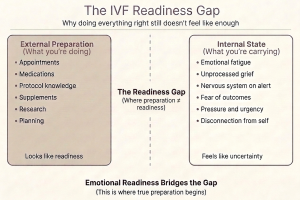
Many women preparing for IVF focus on the medical steps, but emotional readiness for IVF can still feel out of reach. You can be doing everything right before IVF and still not feel ready inside.

That is not a personal failure.
It is a preparation gap.
And it is one that is rarely named.

What “Prepared” Looks Like Before IVF

When a woman prepares for IVF, she is guided through a clear and structured process.

She learns about the protocol.
She understands the medications.
She attends appointments.
She asks questions.
She follows every step carefully.

From the outside, this looks like readiness.

She is informed, organised, and doing everything she has been told will support her chances.

And yet, for many women, there is a quiet feeling underneath all of this.

Something is not quite steady.

The Readiness Illusion

This is what I call the Readiness Illusion.

It is the experience of being fully prepared on paper, while internally feeling depleted, uncertain, or disconnected.

A woman can be highly capable and deeply committed, and still not feel resourced for what lies ahead.

Not because she has missed a step.
But because of what she has already been carrying.

What IVF Preparation Often Doesn’t Account For

By the time a woman reaches IVF, she has often already been through a long and demanding journey.

Months, sometimes years, of trying to conceive.
Cycles of hope followed by disappointment.
Decisions, appointments, waiting, and uncertainty.

Over time, the nervous system adapts.

It learns to stay alert.
It learns to brace.
It learns to keep moving forward, even when there has been little space to process what has happened.

From the outside, this can look like resilience.

But internally, something may have shifted.
Not broken.
But no longer fully resourced.

Research in chronic stress and allostatic load helps us understand this more clearly.

When a system has been under prolonged demand, it does not automatically return to a regulated state simply because circumstances change.
It often continues to operate in a more protective mode.

In the context of IVF, this means a woman may enter treatment with a well-prepared body, but a nervous system that is still quietly bracing for what comes next.

She is functioning.
She is continuing.
She is managing what needs to be managed.

But she may no longer be operating from a place of internal steadiness.

That distinction matters.

Why This Matters for IVF

IVF is not only a medical process.
It is an emotional one.

It asks a great deal of a woman, not only physically, but mentally and emotionally.

The decisions.
The waiting.
The uncertainty.
The outcomes.

If she enters this process already depleted, already carrying a significant emotional load, that state may quietly shape every stage of treatment.

Without emotional readiness for IVF, even the most well-planned cycle can feel heavier than it needs to be.

This is not about blame.
It is about recognising that preparation is incomplete if it only addresses the body.

Emotional Readiness: The Missing Piece

Emotional readiness is not about being calm or positive.
It is not about eliminating fear before your first injection.

It is about being resourced enough to stay present with yourself through a process that matters deeply to you.

I know what it looks like when that resource runs out, because I have been there.

By 35, after years of fertility challenges, I reached a point of complete depletion.
Physical exhaustion, emotional strain, and a sense that I could not continue in the way I had been.

I stepped away.

What followed was a period of rebuilding.
My health, my emotional capacity, and my relationship with my own body.

At the time, I did not realise that this work would become the foundation of everything I now teach.

When I entered IVF at 39, something had shifted.

I was no longer bracing in the same way.
I was not pushing through.
I felt more steady within myself.

And I have come to understand why that matters.

The body often responds differently when the nervous system is no longer in a sustained state of protection.

Emotional readiness for IVF is not separate from the physical process.
It sits alongside it.

A Different Way to Prepare

If you are preparing for IVF, this kind of preparation may begin with something quieter than another supplement or another appointment.

It begins with an honest check-in.

  • What is actually happening inside you, not just what you are doing
  • What your body has been holding across this journey
  • What still feels unresolved
  • Where you have support, and where you may need more
  • What “ready enough” looks like for you, not perfect readiness, but sufficient support

This is not about fixing yourself before you are allowed to proceed.

It is about understanding your starting point, so that treatment does not happen in spite of your emotional state, but alongside it.

IVF Prepares the Body. Emotional Readiness Prepares the Woman.

The medical side of IVF is essential.
But it is only one part of the preparation.

When emotional readiness for IVF is included alongside clinical care, something shifts.

A woman does not need to force herself into readiness.
She can be supported into it.

A Gentle Place to Begin

If something in this resonates, it may be helpful to gently understand where your system is currently sitting before your next step.

The IVF Emotional Readiness Scorecard is a simple, 7-minute check-in designed to help you see how steady, supported, and prepared you feel before entering treatment.

It is not a test.
It is a starting point.

With gentle hope,
Margaret Cali 💜
Fertility & Mindset Coach


https://www.margaretcali.com.au/wp-content/uploads/2026/03/Post-diagram-Why-Dong-Everything-Right-Still-Doesnt-Feel-like-Enough.jpg 675 1200 Margaret Cali https://www.margaretcali.com.au/wp-content/uploads/2026/07/Margaret-Cali-Logo-New.png Margaret Cali2026-03-22 20:47:372026-10-12 20:49:18Why Doing Everything Right Still Doesn’t Feel Like Enough

Margaret Cali

Recent Posts

  • Your First IVF Appointment: How to Prepare Emotionally
  • What Is IVF Coaching? A Plain-English Guide
  • What Do People Ask an IVF Coach? Common Fertility Coaching Questions Answered
  • Am I Emotionally Ready for IVF? Six Situations to Consider
  • The Two-Week Wait After IVF: How to Cope Without Living Tomorrow Today
  • What Whole-Woman Readiness Means Before IVF
  • How to Prepare Emotionally for IVF Before Treatment Begins
  • Feeling Overwhelmed Before IVF Begins: Why It Happens and What Helps
  • Why Doing Everything Right Still Doesn’t Feel Like Enough
  • Protection Mode vs Creation Mode: The Missing Conversation in IVF Preparation
  • Emotional Shutdown During Fertility: When “I’m Fine” Is a Survival Response
  • Why IVF Feels So Hard on Your Relationship And What It’s Really Trying to Show You
Search Search

Contact Margaret

T: 0409 304 003
E: mcalicoaching@gmail.com
A: Ashbury NSW 2193

Member, Fertility Society of Australia and New Zealand (FSANZ)

© 2026 Margaret Cali. All rights reserved.

Business Hours

Monday: 9am – 5pm
Tuesday: 9am – 5pm
Wednesday: 9am – 5pm
Thursday: 9am – 5pm
Friday: 9am – 5pm

Based in Australia, I also support clients internationally. Sessions are by appointment, with flexible times to suit busy schedules and different time zones.

Recent Posts

  • Your First IVF Appointment: How to Prepare Emotionally
  • What Is IVF Coaching? A Plain-English Guide
  • What Do People Ask an IVF Coach? Common Fertility Coaching Questions Answered
  • Am I Emotionally Ready for IVF? Six Situations to Consider
  • The Two-Week Wait After IVF: How to Cope Without Living Tomorrow Today
Scroll to top Scroll to top Scroll to top