
Emotional Shutdown During Fertility: When “I’m Fine” Is a Survival Response
There is a particular phrase many women learn to say during fertility struggles:
“I’m fine.”
It’s offered in work meetings, in conversations with friends who don’t know what to ask, and sometimes even to partners or clinicians. On the surface, it sounds reassuring. But for many women navigating fertility challenges or IVF, this phrase isn’t reassurance at all.
It’s a survival response.
What Emotional Shutdown Really Looks Like
Emotional shutdown is rarely dramatic. It doesn’t always involve tears or visible distress. More often, it shows up quietly, in ways that are easy to miss.
It may look like:
-
staying busy or highly productive to avoid feeling
-
feeling flat or numb rather than actively sad
-
minimising your emotions to keep others comfortable
-
functioning well on the outside while feeling disconnected inside
Internally, something has gone quiet. Not because you’re weak or avoiding reality, but because your nervous system is protecting you from overload.
The Science of Protection: Hypo-arousal and Fertility Burnout
When fertility challenges are prolonged or medically complex, the repeated cycle of hope and disappointment keeps the stress response switched on. Over time, the body may move out of fight-or-flight and into hypo-arousal.
This is a state of emotional blunting or withdrawal. It’s the nervous system’s way of saying, “This is too much to feel all at once.”
In my work, this often appears alongside fertility burnout. Women are not just tired. They’re depleted after years of managing uncertainty, pressure, and private grief.
Shutdown can feel safer than:
-
answering questions you don’t have the energy for
-
risking hope again
-
fully feeling what has already been lost
This response is not a failure. It’s adaptive.
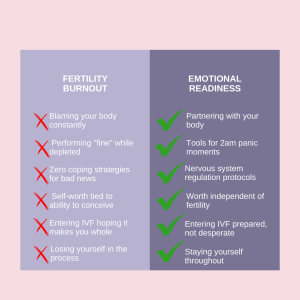
Fertility burnout isn’t a personal failure. Emotional readiness is a supported state.
When Shutdown Becomes a Self-Worth Crisis in Disguise
When emotional shutdown lasts too long, it can quietly erode self-worth.
Women often begin to:
-
measure their value by test results
-
equate outcomes with personal success or failure
-
disconnect from their identity outside fertility
-
feel invisible, even in supportive relationships
This is not because something is wrong with you. It’s what happens when emotional load goes unrecognised for too long.
Why Emotional Readiness Matters Before IVF
Many women enter IVF medically prepared but emotionally depleted. Years of fertility burnout mean emotional resources are already low before treatment begins.
When shutdown goes unrecognised, IVF can feel even more isolating. Decisions feel heavier. Communication with partners becomes strained. Women often describe going through the motions while quietly disappearing inside.
This is why emotional readiness matters before IVF begins.
Emotional readiness does not mean being calm or positive all the time. It means having enough internal safety to stay connected to yourself while navigating uncertainty.
Bridging Survival Mode Back to Clarity
In my work as a Fertility and Mindset Coach, the focus is never on forcing emotions open or “pushing through.” Instead, it’s about restoring safety first.
Through The RISE Method and my Holistic Fertility Foundations Framework (ALIGN), I support women to gently move out of survival mode and back into a state of clarity, steadiness, and self-trust. These frameworks are grounded in nervous system regulation, emotional integration, and body partnership, rather than pressure or performance.
I bring over 30 years of professional experience in leadership and education, blending evidence-informed approaches with compassionate coaching. I also know this road personally. My own journey through PCOS, pregnancy loss, and male factor infertility eventually led to IVF success at age 40.
That combination of lived experience and structured emotional frameworks allows women to reconnect with themselves without overwhelm, and to enter IVF feeling prepared rather than depleted.
Reconnecting Without Forcing Emotion
Reconnection doesn’t require you to feel everything at once. In fact, forcing emotion can deepen shutdown.
Gentle reconnection begins with:
-
Acknowledgement: recognising shutdown as protective, not pathological
-
Nervous system regulation: restoring internal safety before demands increase
-
Permission: meeting yourself where you are, without judgement
You are not broken.
You are not cold.
You are not failing at coping.
You are carrying a lot.