
Why Doing Everything Right Still Doesn’t Feel Like Enough
Many women preparing for IVF focus on the medical steps, but emotional readiness for IVF can still feel out of reach. You can be doing everything right before IVF and still not feel ready inside.
That is not a personal failure.
It is a preparation gap.
And it is one that is rarely named.
What “Prepared” Looks Like Before IVF
When a woman prepares for IVF, she is guided through a clear and structured process.
She learns about the protocol.
She understands the medications.
She attends appointments.
She asks questions.
She follows every step carefully.
From the outside, this looks like readiness.
She is informed, organised, and doing everything she has been told will support her chances.
And yet, for many women, there is a quiet feeling underneath all of this.
Something is not quite steady.
The Readiness Illusion
This is what I call the Readiness Illusion.
It is the experience of being fully prepared on paper, while internally feeling depleted, uncertain, or disconnected.
A woman can be highly capable and deeply committed, and still not feel resourced for what lies ahead.
Not because she has missed a step.
But because of what she has already been carrying.
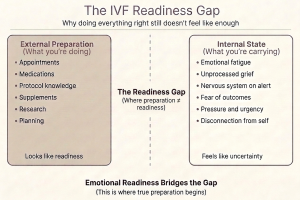
What IVF Preparation Often Doesn’t Account For
By the time a woman reaches IVF, she has often already been through a long and demanding journey.
Months, sometimes years, of trying to conceive.
Cycles of hope followed by disappointment.
Decisions, appointments, waiting, and uncertainty.
Over time, the nervous system adapts.
It learns to stay alert.
It learns to brace.
It learns to keep moving forward, even when there has been little space to process what has happened.
From the outside, this can look like resilience.
But internally, something may have shifted.
Not broken.
But no longer fully resourced.
Research in chronic stress and allostatic load helps us understand this more clearly.
When a system has been under prolonged demand, it does not automatically return to a regulated state simply because circumstances change.
It often continues to operate in a more protective mode.
In the context of IVF, this means a woman may enter treatment with a well-prepared body, but a nervous system that is still quietly bracing for what comes next.
She is functioning.
She is continuing.
She is managing what needs to be managed.
But she may no longer be operating from a place of internal steadiness.
That distinction matters.
Why This Matters for IVF
IVF is not only a medical process.
It is an emotional one.
It asks a great deal of a woman, not only physically, but mentally and emotionally.
The decisions.
The waiting.
The uncertainty.
The outcomes.
If she enters this process already depleted, already carrying a significant emotional load, that state may quietly shape every stage of treatment.
Without emotional readiness for IVF, even the most well-planned cycle can feel heavier than it needs to be.
This is not about blame.
It is about recognising that preparation is incomplete if it only addresses the body.
Emotional Readiness: The Missing Piece
Emotional readiness is not about being calm or positive.
It is not about eliminating fear before your first injection.
It is about being resourced enough to stay present with yourself through a process that matters deeply to you.
I know what it looks like when that resource runs out, because I have been there.
By 35, after years of fertility challenges, I reached a point of complete depletion.
Physical exhaustion, emotional strain, and a sense that I could not continue in the way I had been.
I stepped away.
What followed was a period of rebuilding.
My health, my emotional capacity, and my relationship with my own body.
At the time, I did not realise that this work would become the foundation of everything I now teach.
When I entered IVF at 39, something had shifted.
I was no longer bracing in the same way.
I was not pushing through.
I felt more steady within myself.
And I have come to understand why that matters.
The body often responds differently when the nervous system is no longer in a sustained state of protection.
Emotional readiness for IVF is not separate from the physical process.
It sits alongside it.
A Different Way to Prepare
If you are preparing for IVF, this kind of preparation may begin with something quieter than another supplement or another appointment.
It begins with an honest check-in.
- What is actually happening inside you, not just what you are doing
- What your body has been holding across this journey
- What still feels unresolved
- Where you have support, and where you may need more
- What “ready enough” looks like for you, not perfect readiness, but sufficient support
This is not about fixing yourself before you are allowed to proceed.
It is about understanding your starting point, so that treatment does not happen in spite of your emotional state, but alongside it.
IVF Prepares the Body. Emotional Readiness Prepares the Woman.
The medical side of IVF is essential.
But it is only one part of the preparation.
When emotional readiness for IVF is included alongside clinical care, something shifts.
A woman does not need to force herself into readiness.
She can be supported into it.
A Gentle Place to Begin
If something in this resonates, it may be helpful to gently understand where your system is currently sitting before your next step.
The IVF Emotional Readiness Scorecard is a simple, 7-minute check-in designed to help you see how steady, supported, and prepared you feel before entering treatment.
It is not a test.
It is a starting point.
With gentle hope,
Margaret Cali 💜
Fertility & Mindset Coach